Showing posts with label john o'brien. Show all posts

Thursday, October 29, 2015

Post drenched in tears


Bill and John O'Brien, circa 1985

The film "Leaving Las Vegas" debuted 20 years ago this week. The anniversary was noted by Esquire and The Fix.

I invite you to read those musings if you are thusly inclined, but as for me, I will repost this story, which I love. It's about John and Dad and the sort of memory that I carry in that poor old sad/sweet part of my heart. I first posted this in February 2010.


Yeah, yeah.

*  *  *

In the summer of 1980, my family attended a weekend party in Columbus, about 120 miles south of Cleveland. I was 15 and went with my parents in their Honda Accord hatchback. My brother and his wife Lisa drove in their lime green Triumph TR7.

On Sunday, Johnny and Lisa left for the return trip about a half hour before the rest of us. Mom, Dad and I were making our way north on I-71 when a green dot appeared in the distance. It was the TR7 on the berm. John was bent over the open hood. Dad pulled over and threw the Honda in reverse.

Dad and John tinkered, ethered and cajoled to no avail (which is saying something). But of course, Dad had a tow rope.

"Hook it onto something that won't pull off," he yelled to John over the noise of the careening traffic.

Dad shifted into first and inched the Honda forward until the rope drew taut between the two cars. John hopped into the Triumph and our precarious caravan of two pulled onto the highway. It was 70 miles to Cleveland.

Behold a rare juncture when I may rightly divide the human population into two groups:

1) Those who understand the implication of a tow rope.

2) Those who do not understand the implication of a tow rope.

The tow rope experience is akin to a dog leash--sort of. Although both parties have brakes, only the leader has accelerating power. If the tow-er (as in one who tows) brakes too hard, he risks getting rear-ended by the towee. If the towee brakes too hard, he's "chewing up" the tower's clutch--or worse (think of pulling back hard on a dog's leash). If the tower accelerates too fast, the towee is subject to a lurch. it goes on and on. The tow rope itself is always in danger of snapping (not good when traveling 60+ MPH on a highway). So for those number 2's out there: using a tow rope is really tricky and should never exceed one or two miles.

But seventy miles with a tow rope? The prospect was insane.

In 1980, there were no cell phones. Communication during that trip was reduced to brake lights and exaggerated gestures poorly communicated by way of our rear-view mirror and windshields. At one point Lisa started to repeat a spell-casting gesture with splayed fingers and a frantic look on her face.

"Lisa's trying to tell us something!" I said.

"What's it mean? What's it mean?" said Mom as Lisa's motions repeated again and again.

"WAIT! I've got it!" said Mom. "She's counting ... TEN ... TWENTY ... THIRTY ..." I started in with her. We made it to about 60 before Dad rolled his eyes.

"The emergency flasher," he said, "they want us to turn off the emergency flashers." And we all laughed despite the tension.

Dad wasn't one to let circumstances interfere with lifestyle. He sipped beer for the whole trip.

"Hand me another Stroh's, Skeeziks."

The end was the worst--4.5 miles of dense city traffic between the I-71/West 150 exit and 14000 Lake Avenue. It isn't easy to navigate two cars tethered with a rope through an urban route of stoplights and turns, but despite the impossible odds, Dad and John got both cars home unscathed (although Dad would always say that the Historic Tow of 1980 ate a good bit of the Honda's clutch).

"Holy Christ," said Dad with relief as we finally pulled into the drive.

Holy Christ, indeed.

* * *

Thursday, January 01, 2015

Less for 2015


VPRO's Shot on Location: Leaving Las Vegas
from FrithMedia on Vimeo
.

The Dutch media outfit VPRO contacted me in summer of 2012 about filming that 30-minute documentary on Leaving Las Vegas. I flew to Las Vegas in December to do the interview and the film came out in 2013. I didn't see it until VPRO sent me a DVD later in the year.

When it became available online, I didn't share it. In fact, I didn't talk at all about appearing on "Shot on Location" to anyone other than Eric and a few other people. This was all I posted about the trip here along with a few photo updates on Facebook and Twitter. As the readership knows, it sometimes takes me a long time to process things associated with my brother John. I'm sharing this now because I'm ready.

There is another reason.

I was none too happy with the way I looked in the film, but I've finally done something about it. I dropped about 25 pounds in 2014. In a day or two, I'll post specific tips on how I did it.

Welcome Erin 2.015

Photo by Bob Perkoski
Fresh Water managing photographer Bob Perkoski took this photo a few weeks ago at the HofbrÀuhaus Cleveland. That's Fresh Water publisher Fran DiDonato, left, and managing editor Lee Chilcote, right. 

So there I am, John, a work in progress on many fronts. Know that I'm trying. I'm trying as hard as I can and I miss you with all of my heart.

Onward--

*  *  *

Monday, October 27, 2014

Leaving Las Vegas: the aftermath


John and me, 1986

On Wednesday, November 5 from 7:30 to 9 p.m., I'll be giving a very personal talk about how the tragedy of my brother John’s 1994 suicide and the nuanced aftermath led me to the keyboard.

Folks, these are the quiet, tender stories.

This event is free and open to the public. 

Location: Cleveland Psychoanalytic Center, Heights Medical Building, 2460 Fairmount Blvd. Suite 312. Parking is free behind the building.

Please make a reservation:  216-229-5959  or emial dmorsecpc  [at] sbcglobal.net

More information here.

*  *  *

Friday, September 05, 2014

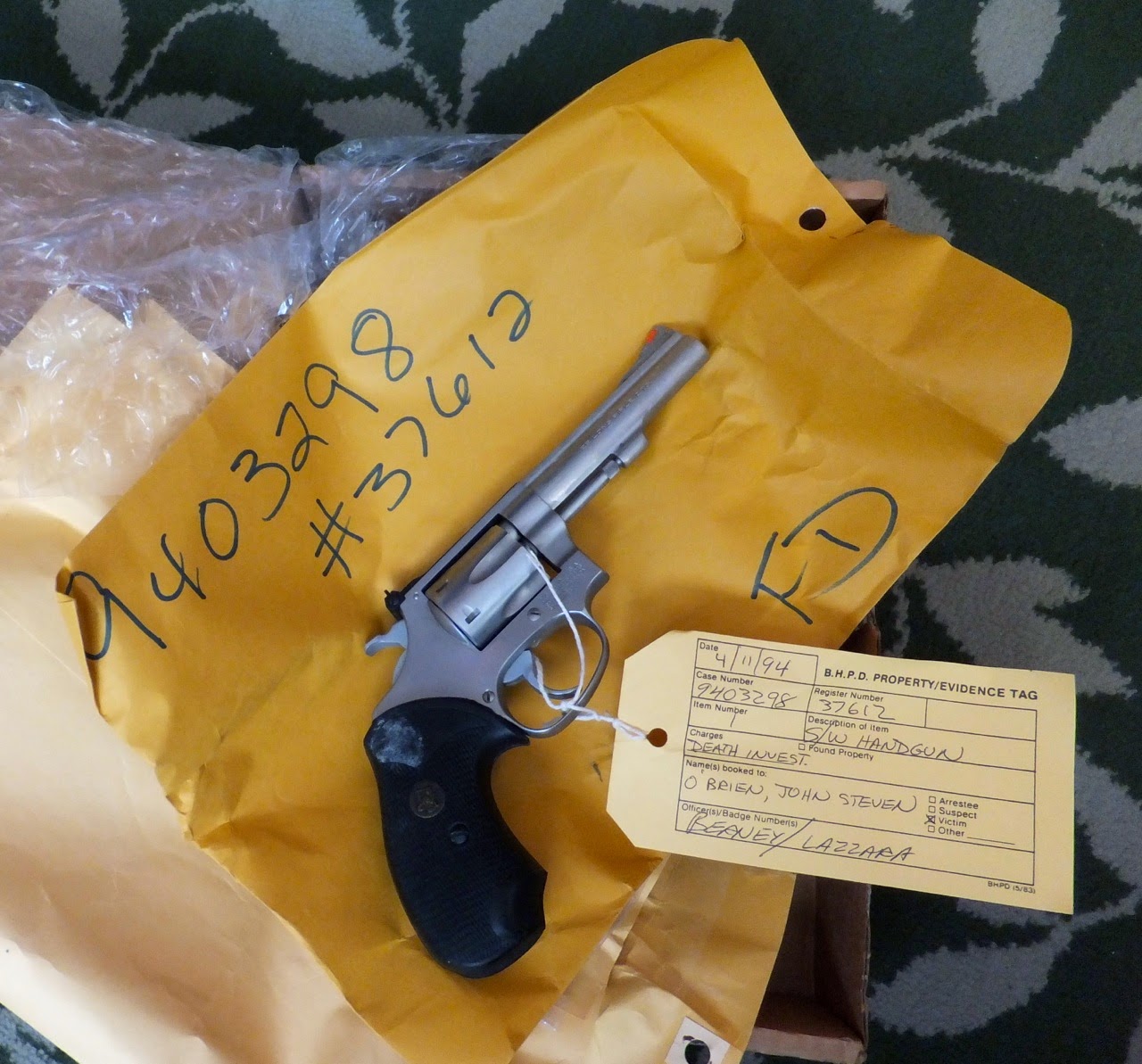
It was last fired on April 10, 1994


Sometimes I just land here. Sometimes the world pushes me here.

When I first returned to work after my brother John's suicide, a coworker said to me, "You know, he cannot be buried in a Catholic cemetery."

That was before John's name would become internationally associated with the award-winning film Leaving Las Vegas, although I'm pretty sure that individual would have said the same thing under any circumstances.

One man wrote to tell me he was going to "join" John amid pages of barely comprehensible ranting. One woman wrote me 14 years after John's death to tell me he'd made a pass at her while he was still married.

Once at a terrible book signing wherein I sat by myself at a table for hours with a pristine stack of copies of my novel before me, the one person who came in from the blinding blizzard did not buy my book, but asked me casually, "So, why did your brother kill himself?"

I do my best to mothball the unfortunate comments, but as you can see, they are pretty indelible. Hence, I did not comment on Robin Williams' death, but it did move me to this post.

The Grim Reaper and I are old friends. I know his ways all too well. He'll let you say goodbye to just about everyone, but you will never lay down a suicide. It is a badge he sews into your flesh.

Read this:


At some point after Dad's death, Mom gave that box to Eric. It remained sealed until nearly 19 years after John's death.

Nineteen years.

On January 4, 2013, some cosmic switched toggled. It was time. Someone had to verify the gun--acknowledge it--and it had to be me. I asked Eric to dig the box from wherever he'd stowed it. He did. When he handed it to me, it was at once too heavy and too light. I could not open it. I handed the box back to Eric as queasiness overwhelmed me from my stomach to my head. I was shaky and flushed.

As he worked through the wrapping, I thought, what will you do if it's covered in dried gore?

The masculine tailored look of the Smith and Wesson, a terrible handsome thing, was not lost on me. It was exactly the gun I would have expected John to select, which was oddly painful: to not be surprised by it.

The evidence tag was another story. I had not expected that: written verification on the inside of what Dad refused to acknowledge on the outside of this box. That rote slip of paper amid all this blood and emotion struck me at my core.


I could not touch the gun, but documentation seemed important. I don't know why. I took the photos and Eric took it all away.

Perhaps the heaviest burden associated with John's death is the dichotomy of the act: was it the zenith of cowardice or bravery? After 20 years and countless hours studying his body of work, I've concluded that it was both. Whether I'm right or wrong isn't the point. I deserve the modest liberation it affords.

This is what it is like. This is exactly what it is like.

Bill and John O'Brien, circa 1961

*  *  *

Friday, January 24, 2014

Death Valley, piece by piece


Puzzles come in. Puzzles go out. Some puzzles stay.

I buy new puzzles, used puzzles and collectible puzzles. I have a couple of very expensive puzzles. I choose them based on a host of criteria. Sometimes I am compelled by the image. Sometimes I like the shapes of the pieces or the quality of the puzzle. I love fine art puzzles and vintage puzzles. Despite my advanced age, I love puzzles with candy images. No thanks to heartwarmers or fantasy themes. I don't care much for touristy/landmark puzzles unless I am compelled to them for some quirky reason or if they have a quiet emotional tether.

Which brings me to the Death Valley puzzle.

I've had it for the longest time. Ten years? At least. Maybe longer. I'm not sure where I bought it; probably at a thrift store or garage sale. It no doubt originally came from the sole gift shop in Death Valley, which still carries it.

Johnny, 1972
Death Valley is a strange, mystical place. My brother John wanted his ashes strewn about this low dry land, although they only made it as far as the Mohave Desert--I think (it's a long and sad story with many missing pieces). Nonetheless, Death Valley was important to John and he conjured it in his novel The Assault on Tony's by way of a single word. From page 57:

Langston nodded, gulping. Such was McTeague.

I had no idea what McTeague meant when I first saw that short paragraph. Being so strangely phrased and precisely placed, I knew it had to be important. I investigated. It didn't long take to discover Frank Norris's 1899 novel of the same name.

Although far from John's best work, for me Tony's remains the most definitive and maddening entry in his portfolio. Profoundly personal, it is all commentary and metaphor. John's mention of McTeague is the most economic literary reference I have ever encountered. The dramatic arc of McTeague, which is a bizarre tale of greed and hoarding, concludes in a devastating scene in Death Valley. Hence with one word, John culminates those themes as well as booze, addiction, life and death--ideologically and geographically.

Death Valley.


When I reshuffled my puzzle collection a few weeks ago, I came upon the Death Valley puzzle and couldn't remember if it was complete. Souvenir puzzles are often poor quality, but this one has it's merits. The pieces are diverse and oddly shaped. The cardboard is sturdy. The image adherence is good. The pieces of this puzzle, however, do not have a snug fit. Some are warped and do not lay flat. I constructed the puzzle nonetheless, thinking about John and Tony's and Death Valley and McTeague.

The loose fitting pieces were frustrating. They wouldn't stay put, even after they were correctly placed. The on-deck pieces kept sticking to my forearms. Once completed (no pieces were missing), the puzzle was tenuous at best.

The two least enjoyable stages of jigsaw puzzling are at the beginning (laying out all the pieces) and at the end (taking the puzzle apart). Some puzzles fit together so tightly, you can pick the constructed puzzle up as a single unit. Such puzzles often have to be taken apart piece by piece. I am notoriously bad at deconstructing puzzles, often leaving big chunks of stubborn puzzles intact.

But when the time came to take apart the Death Valley puzzle, no deconstruction was necessary. Not one piece seemed committed to the pieces around it, as if they had no conviction to maintain the whole from whence they came. The puzzle just crumbled apart in my hands.

I fumbled with the indifferent pieces as John's ghost chortled.  I sighed and put them into their box. John folded back into his papery grave.


*  *  *

Monday, October 15, 2012

John and me in our hometown

On this Wednesday, Oct. 17, at 7 p.m. in Lakewood Public Library's main auditorium, I'll talk about how the tragedy of my brother John's 1994 suicide led me from the corporate world to the keyboard.

I'll also discuss a writing life lived mostly in the trenches and eventually celebrated in humor in The Irish Hungarian Guide to the Domestic Arts, which the Plain Dealer's Michael Heaton calls, "whip-smart, heart-felt and subversively funny enough to cause unsuspecting readers to choke on their guffaws."

John and I grew up in Lakewood and are both Lakewood High School grads.

Of course I'll be taking questions on my writing as well as my brother's body of work, which includes his groundbreaking 1990 novel Leaving Las Vegas. 

Copies of The Irish Hungarian will be available for sale and signing at this free public event.

I would sure love to see you.

*  *  *

Thursday, May 31, 2012

The Grim Reaper, part one

An excerpt from an unfinished book of memoir.

*  *  *

The Grim Reaper is dressed in Chinos and an over-sized windbreaker. His name patch says Grim in golden letters. He sits opposite Erin, a dark-haired woman in her late twenties.

"You're not what I was expecting," says Erin.

"I get that a lot," says Grim. "No idea where the black-cloak-and-scythe thing came from."

"So what's with the jacket?" she asks. "You hiding Mini Grim in there?"

The Grim Reaper cocks his head and gives Erin a quizzical look.

"Never mind," says Erin. Her eyes dart around the room. "I have a question."

"Shoot," says Grim, who then starts to chuckle. "Get it?" he says through a laugh. "The Grim Reaper?" He quakes. "Saying 'shoot'?" He hissles and snorts.

"Hysterical," says Erin flatly. "So where is he?"

"Where's who?" says Grim.

"My brother," says Erin. The Grim Reaper blinks at her in confusion. "Hello?" says Erin. "Your latest arrival?"

Recognition blooms. "Oh, yeah," says Grim, "yeah yeah yeah yeah. He was the Leaving Las Vegas guy, right? And you’re the sister."

"Brilliant," says Erin, indicating her tee shirt upon which SISTER is printed in bold letters. "But yeah, that's right," says Erin, "the Leaving Las Vegas guy. And I'm the sister. And his name is John."

"You mean his name was John."

"Fine," says Erin. "Whatever you say. Just tell me where he is."

"Gone."

"What do you mean, gone?"

"Gone," says Grim. "Dead. He croaked. He's gone."

"But what about the guy with the horns and red suit? What about the reincarnation people and all that Déjà vu stuff? What about the light?" asks Erin, her irritation rising. "I'm talking about the hereafter. There must be some sort of hereafter." her voice rises. "He can't just be gone."

"Yes he can, Sis. I know what I'm talking about. Hey, I'm the Grim Reaper. And if you don't believe me, just take a look at my name patch."

Fury colors Erin's cheeks. She stands and squares her fists on the table. "You prick," she says, "you tell me where he is. You tell me now."

The Grim Reaper lets out a big sigh. "Ms. O'Brien," he says, "I wish I had your answer, but I don't. I'm just a working stiff." He stifles a giggle. "What I do is a one shot ... um ... I mean .... one time transaction."

Erin does not respond.

"You drive that baby off the lot and it's a done deal," says Grim. "Get it?"

"Done deal," says Erin. She stares at him blankly for a long beat before deflating back into the chair.

"Mind if I smoke?" says the Grim Reaper.

"Be my guest," says Erin, pushing an ashtray across the table. Erin gazes at nothing while the Grim Reaper smokes. Neither says anything for ten thousand years.

"You do realize," says Erin finally, "that once we're all gone, you'll be obsolete."

The Grim Reaper exhales a plume of smoke with disgust. "Did you really have to remind me?"

*  *  *

Monday, September 05, 2011

Telephone conversation

The following conversation regarding my brother John O'Brien's posthumous novel, Better (Akashic, 2009), took place during the publication process.


Me: Hi Mom.

Mom: Hi hon.

Me: Mom, I'm about to send the final version of Better off to Akashic and I wanted to check in with you first. Is there anything in the book you want to talk about?

Mom: That one scene. I hate that one scene.

Me: Which one?

Mom: The one where he urinates on the floor. Do you know the one I'm talking about?

Me: I do.

Mom: I hate that scene.

Me: I know, Mom.

Mom: It's disgusting. Johnny would never do anything like that.

Me: Of course he wouldn't.

Mom: Maybe you should take it out.

Me:

Mom:

Me: I'd really hate to do that.

Mom:

Me: I don't think the scene has anything to do with John. It's about the character. The character is trying to verify he's alive. He needs to hear a sound that's ... primal.

You know how careful John was about his writing. Every word had a purpose. I really think it should stay, Mom. I really do. It's about being alive. It's important.

Mom:

Mom:

Mom:

Me: John would be furious to see it deleted.

Mom: I guess you're right, but I still don't like it.

Me: I understand that. Try to separate it from Johnny. If he were here, he'd tell you it's about the character. You know I hate to put words in his mouth, but I think I've got this one right.

Mom:

Me: I'm doing the best I can.

Mom: I know you are.

Me: Should I send it along to Akashic then? Is there anything else we should talk about?

Mom: No. If you're happy with it, that's fine.

Me: I'm not sure "happy" is the right word.

Mom: I know. You know what I mean.

Me: I do. Okay then, I'll get this going.

Mom: Okay. Love you.

Me: Love you.


Excerpt from Better:
Suddenly I am aware that the house is positively silent. There is absolutely no aural evidence that any animate thing occupies this house. For all I hear right now, I could be alone. Even the sounds of my own body eludes me. The perennial hum of the world at large: not there. The cumulative buzz of myriad ticks and tocks that drifts into our ears twenty-four hours a day: missing. The orchestration of every noise ever made anywhere, perpetually and reliably amalgamated then distilled down to a back-of-your-head IV of mild distraction in a sucrose base: history.

I do stand. I am in need of a noise. I hit the table with my glass: bok. Not enough--I need a longer noise. I slap myself. Again. Listen: still nothing. I can't possibly be alone here; I know better. Afraid to listen to my watch, much less look at it, my eye instead falls on a remote for the televisions. I can't touch it; I am afraid that if I reach for it, I might lose my balance, fall and strike my head, die in this pervading silence. My eyes blur. My bladder burns. It seems a very long time since I last urinated--too long for a living man. Still standing by the bar, I unzip my fly: zzzip. I pull out my penis; it seems pitifully small, and I can hold it between my thumb and my forefinger. It takes time, then finally there is liquid. At first a mere dribble trickling along my finger and dripping off the knuckle, it grows in force and becomes a steady stream under pressure which separates from my finger and finds its own path. It hits the floor, fairly quietly at first but soon announcing itself with a rumble as it stakes out its puddle and continues falling upon itself, no longer absorbed by the shocked carpet. It's now loud: patapatapatapata. It feels good to hear it. It smells bad, for I have held it too long; nonetheless, it feels good to smell it.

And much to my relief, when the splashing ends, it is replaced by the regular sounds of the house, the city, the rest. I hear water running--plumbed water--in one of the bathrooms. An airplane passes overhead. Probably an antique from Santa Monica airport, for it has that precarious cough that haunts old black and white movie soundtracks. Once the bane of inevitably smaller-than-life airmen, it has no doubt become something to be achieved, duplicated, recaptured in its authenticity, like the dying, spitting, last-time-out-before-the-snow-flies sound of a well-tuned Harley. I hear other things. I hear a trillion things, all of them rich and cogent messengers; they sing to me of my continuing sanity.


* * *

John O'Brien died in April 1994 from a self-inflicted gunshot wound at the Beverly Hills apartment building featured in these photographs.

Further reading.


* * *

Wednesday, June 15, 2011

John O'Brien and Vegas Mavens

Bill, Erin and John O'Brien, 1970

 Vegas Mavens has posted an essay about my brother John and his novel Leaving Las Vegas.

During our interview, Mavens writer Josh and I discussed one of my favorite passages from the book that appears on page five. This burst of poetry and geometry absolutely dazzles me:

His point was made, and he moved along, in keeping with the tangential nature that must consume at least one of them. There is a bottle in his future--perhaps sooner a glass--elsewhere on the line. Sera is a circle, twenty-nine years around.

There is a woman (a circle) and a man (a straight line). The metaphor is perfect in it's every permutation: in the primal symbols of female and male, and in the visual moment when Ben and Sera first glance off each other. Their tangential one-point contact is also an accurate representative of their relationship as a whole. His line does not bisect the circle or thread through it's middle just as Ben does not penetrate Sera.

After their brief and chaste affair, Sera will continue to roll around her diameter and Ben's line will plod on. That line is resolute in its path and the liquor that marks it. Whether it comes to an end or continues along towards a spiritual vanishing point depends on the reader and how he spends his Sunday mornings. Sera's age, 29, is a prime number, divisible only by itself and the number one (how much do I love that?).

Hence on page five, John has effectively diagrammed his entire novel in 50 easy words.

All I can do is sigh. All I can do is shake my head. All I can do is put my fingers on the goddamn keyboard.

Goddamn.

Josh and I talked and talked and talked, but we didn't get to all of it. There are parts of the film that I like very much, such as the sad melodic opening:


Insider note: At 3:06, Stuart Regen walks through the set in a cameo appearance. It is perhaps subtler than those of Richard Lewis and Steven Weber, but far more significant. Long before Ben and Sera glittered on the silver screen, Regen plucked a copy of Leaving Las Vegas from a bargain book bin because he liked the cover. He purchased the book for one dollar and subsequently fell impossibly in love with the story. He optioned the rights for $2,000.

Without Stuart Regen, Leaving Las Vegas would never have been made into a film. He succumbed to non-Hodgkin's lymphoma in August, 1998.

*  *  *

Thanks again to Josh for an evocative and fresh viewpoint on the Leaving Las Vegas story and John.

*  *  *

Tuesday, August 10, 2010

Setting the record straight

Back in May, the Hollywood Reporter ran a front page story about Lily Zanuck and my brother's posthumous novel "The Assault on Tony's."

The article took Mom and me completely by surprise. All of the rights regarding the film option for "The Assault on Tony's" remain as part of John's estate now as they did when the article ran. Furthermore, my name was erroneously listed as Maureen O'Brien, which just goes to show you how thorough the "writer" on the story was, as well as her editors/fact checkers.

I contacted the editorial staff over at Hollywood Reporter about all of this to no avail. Hence, I thought it was time to set the record straight. No matter where you read it on the Internet, as of today, "The Assault on Tony's" is not under option to be made into a movie by anyone.

The Hollywood Reporter article ran a few days before what would have been John's 50th birthday, which I noted in a bit more dignified manner. Yeah yeah.

I'm trying, John. It's hard sometimes, but I'm trying.

* * *

Friday, May 21, 2010

"We're talking about how people communicate."

My brother John would have turned 50 today. He is on my mind of late for reasons I'll keep to myself, but I want to celebrate him nonetheless.

The following is an excerpt from John's last novel The Assault on Tony's, which features five men--wealthy drunks--who barricade themselves in a posh bar as riots rage outside. There is one woman in the book, Jill the barmaid.

Tony's is mostly an emotional landmine for me, but not in this passage. Herein I find only glee. When I read it, I can believe that some things never die. Then of course, it comes to an end. The last shot sluices from the bottle and all I'm left with is an empty glass, a papery grave and my fading memories. Yeah, yeah.

Until then, enjoy this: my favorite pour from John's final effort.

* * *

Day5

“I’m talking about those moments when it becomes clear that a certain new aspect—bad or good—of our life has been accepted by the world at large.” Rudd waxed philosophical over his brandy, his eyes full of arousal, thoughts of his life and what made him good. “I’m talking about the moment of cultural assimilation.”

Jill, seated across from him in the booth, watched as he topped off their glasses. Though she’d hardly touched hers, she was trying to keep a pace of sorts. She wanted to be interested in what he was saying, if for no other reason than to fill the oppressive voids spent watching them all passed out. “I think I know what you’re saying,” she said.

He nodded, anxious to be in receipt of this, her volley. “Let me give you two examples,” he said, mellow yet almost out of breath.

Langston dozed on the benches near the front, a fixture now. He dreamed of small girls, men's daughters.

Osmond, Fenton, and Miles were engaged in conversation at the bar. The latter two kept glancing at Jill and Rudd.

Rudd wore that look on his face, like: bear with me, you’ll get it. “I needed a bandanna—I know, I know: it was for a party, I was going to a Sixties party—so I went into one of those kid’s stores—skates and records, stuff like that—and they had them. The woman asked me what color I wanted, and she held out a red one. She looked at me, presumably waiting to see if I wanted red.” He paused to make sure this had all sunk in, that the significance of a red bandanna was not lost on Jill.

“I don’t think I could see you in a red bandanna,” said Jill. No help.

“Well obviously,” Rudd continued, straightforward, best plan, “that’s why I said to her ‘Jeeze, not red! I wear that and I’ll get shot.’ ‘Does that still happen,’ she said, laughing. And that was it. It was significant because it was such a casual joke. The idea of being shot for wearing the wrong color scarf had become nothing more than a joke. No more: oh yeah, isn’t that awful, or: oh, I know what you mean. It had fulfilled its destiny. It had to become a joke because there was simply no other way to deal with it, no other way to challenge its power.”

Jill was nodding, she was close. “I’m with you,” she said. She was tipsy, thank God.

“Right, right,” said Rudd. He choked down a gulp of brandy. “Nother example, this time a good one. Walking down the street on a sunny Sunday afternoon, just me out for a walk. Semi-residential neighborhood, a few liquor stores and banks, maybe a grocery store...” He paused, momentarily lost. Too much detail, he thought. But that’s the best way, right? Rudd sipped his brandy. “I’m walking, and this car pulled up—a BMW I think, one of those kids’ ones, 320 something. In fact it was full of kids, young women, I should say. The driver, about twenty-five, attractive blonde, leaned over her friend and said to me, ‘Do you know if there’s a Plus machine nearby?’. Not an ATM, she didn’t ask for an ATM. She asked for a Plus machine! She asked a total stranger for a Plus machine, and the best part is: I knew exactly what she meant and where one was. I told her, and she thanked me and drove off. Beautiful, I thought. ATMs are now assimilated, so much so that we need to be more specific when discussing them—”

He was interrupted by Miles, who brazenly wedged his way into their conversation, into the booth and next to Jill. “What are we talking about?” he wanted to know.

Ignoring him, or at least resolved to attempt so, Rudd concluded directly to Jill, “Like the colored bandannas, the Plus machines are now a piece of history. We don’t have to ask about them anymore, it’s not a question. It’s a—”

“What’s a plus machine?” asked Miles of Jill.

She looked to Rudd. She had been nodding too vigorously and now she needed him to answer quick.

“Do you mind, Miles?” challenged Rudd, turning on the man.

She felt she had to jump in with something. “We were talking about how people communicate,” she said.

“Thank you, Jill,” said Rudd, looking at Miles as if declared the victor by the ranking authority. He turned to Jill. “—fact,” he said. “Knowledge. It’s knowledge.”

“Eggheads,” said Miles dismissively, before passing out on the table.

Rudd assessed the situation. “You’re trapped,” he said.

* * *

Wednesday, February 24, 2010

One tow over the line, sweet Jesus


Bill and John O'Brien, circa 1985

In the summer of 1980, my family attended a weekend party in Columbus, about 120 miles south of Cleveland. I was 15 and went with my parents in their Honda Accord hatchback. My brother and his wife Lisa drove in their lime green Triumph TR7.

On Sunday, Johnny and Lisa left for the return trip about a half hour before the rest of us. Mom, Dad and I were making our way north on I-71 when a green dot appeared in the distance. It was the TR7 on the berm. John was bent over the open hood. Dad pulled over and threw the Honda in reverse.

Dad and John tinkered, ethered and cajoled to no avail (which is saying something). But of course, Dad had a tow rope.

"Hook it onto something that won't pull off," he yelled to John over the noise of the careening traffic.

Dad shifted into first and inched the Honda forward until the rope drew taut between the two cars. John hopped into the Triumph and our precarious caravan of two pulled onto the highway. It was 70 miles to Cleveland.

Behold a rare juncture when I may rightly divide the human population into two groups:

1) Those who understand the implication of a tow rope.

2) Those who do not understand the implication of a tow rope.

The tow rope experience is akin to a dog leash--sort of. Although both parties have brakes, only the leader has accelerating power. If the tow-er (as in one who tows) brakes too hard, he risks getting rear-ended by the towee. If the towee brakes too hard, he's "chewing up" the tower's clutch--or worse (think of pulling back hard on a dog's leash). If the tower accelerates too fast, the towee is subject to a lurch. it goes on and on. The tow rope itself is always in danger of snapping (not good when traveling 60+ MPH on a highway). So for those number 2's out there: using a tow rope is really tricky and should never exceed one or two miles.

But seventy miles with a tow rope? The prospect was insane.

In 1980, there were no cell phones. Communication during that trip was reduced to brake lights and exaggerated gestures poorly communicated by way of our rear-view mirror and windshields. At one point Lisa started to repeat a spell-casting gesture with splayed fingers and a frantic look on her face.

"Lisa's trying to tell us something!" I said.

"What's it mean? What's it mean?" said Mom as Lisa's motions repeated again and again.

"WAIT! I've got it!" said Mom. "She's counting ... TEN ... TWENTY ... THIRTY ..." I started in with her. We made it to about 60 before Dad rolled his eyes.

"The emergency flasher," he said, "they want us to turn off the emergency flashers." And we all laughed despite the tension.

Dad wasn't one to let circumstances interfere with lifestyle. He sipped beer for the whole trip.

"Hand me another Stroh's, Skeeziks."

The end was the worst--4.5 miles of dense city traffic between the I-71/West 150 exit and 14000 Lake Avenue. It isn't easy to navigate two cars tethered with a rope through an urban route of stoplights and turns, but despite the impossible odds, Dad and John got both cars home unscathed (although Dad would always say that the Historic Tow of 1980 ate a good bit of the Honda's clutch).

"Holy Christ," said Dad with relief as we finally pulled into the drive.

Holy Christ, indeed.

* * *

Wednesday, August 12, 2009

Tommy, Angelica, Johnny and me


This week, the Cleveland Scene is featuring an excerpt of my brother John's novel Better, with an introduction by Yours Truly, in which I outline the strange connection between my brother and famed Rugrats Tommy and Angelica.

Read it here.


For those itching for more, I offer the following links:

Rugrat's "Toy's in the Attic" part one.

Rugrat's "Toy's in the Attic" part two.

And an essay I wrote on "Better" for the Los Angeles Times last month.

Today's photo of John and me was taken circa 1984, when Rolling Rock and Stroh's were all the rage.


* * *

Sunday, July 19, 2009

On "Better"

As promised, here is the essay on my brother John's novel Better for the Los Angeles Times: "Clues in John O'Brien's Better."

For any new readers looking for more on John, I offer some of my in-depth writing on my brother and his work and an associated blog entry with additional pictures and links. Thanks for dropping in.

Confidential to the city of Los Angeles: Thank you for being you. You give good visit. Also, many thanks for not quaking the earth beneath yourself during my visit. One last thing--and you're probably not going to like this--but the people in your airport look a whole lot like the people in the Cleveland Airport.

Tuesday, July 14, 2009

Notes from atop the San Andreas Fault

I am in Los Angeles. Los Angeles is not Cleveland. No earthquakes yet; but I'll keep you posted.

Here is a an excerpt of Better from today's LA Weekly.

Any So Cal babies out there know where I took today's pic? It's a very famous LA venue.

Steaming hot Book Soup for everyone on Sunset Strip tonight!

I will be on 90.3 WCPN's "Around Noon" show with Dee Perry at 12 p.m. EST on Monday, July 20th. We'll be talking about Better. You can listen to the show live here. If you are interested but can't catch the show live, listen to the podcast. I'll post the link as soon as it's available.

Confidential to readers: I miss my Goat!

Book soup?

This Thursday, I'll be in Los Angeles for an evening in celebration of my brother John and his work, and to launch his last posthumously published novel "Better." The event will be at 7 p.m. at Book Soup on Sunset Boulevard and will also feature Jerry Stahl and Joseph Mattson.

"Better" is a book of many dimensions. The most compelling of which for me is the metaphorical aspect by which John explores his genetic predisposition to his addiction. I have written an essay detailing what's percolating between the lines of "Better" for the Los Angeles Times, which is slated to run on July 19, 2009. If anyone out there can obtain a hard copy of the article for me, I would very much appreciate it. Here's my address:

Erin O'Brien
P. O. Box 470167
Broadview Hts., OH 44147

In the meantime, for those looking for more on John, I offer some of my in-depth writing on my brother and his work and an associated blog entry with additional pictures and links.

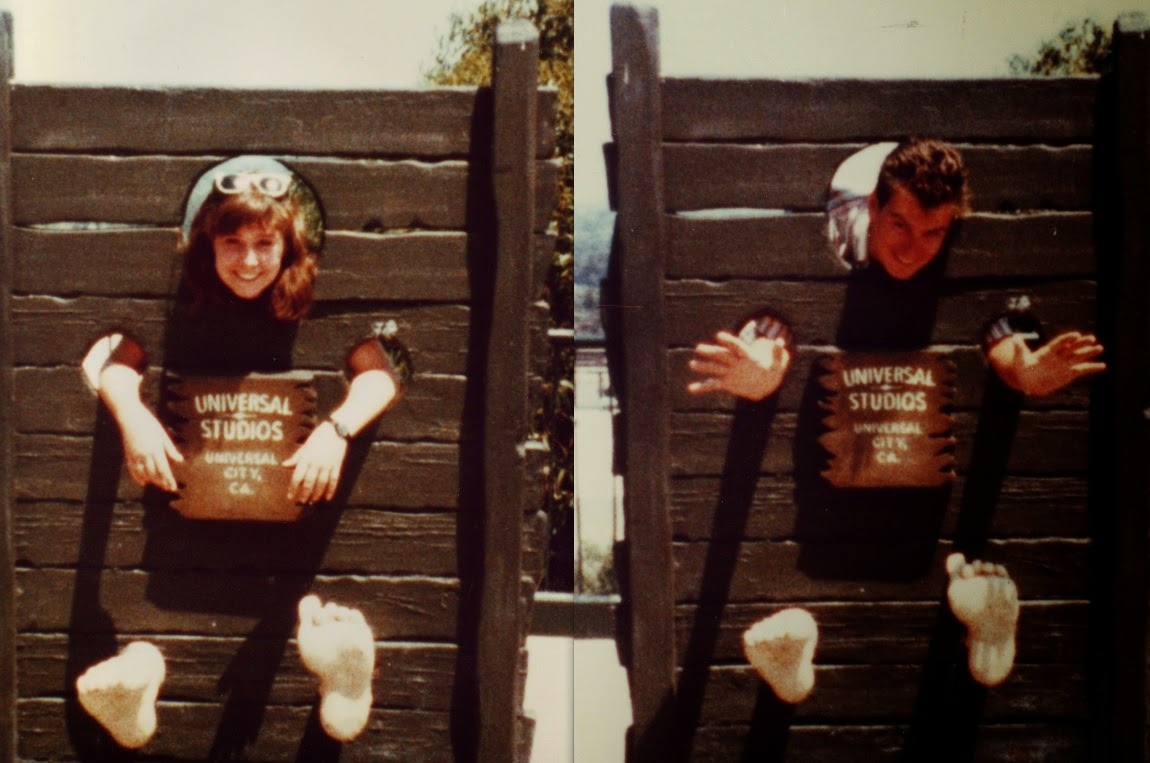
Now here's pix of John and me at Universal Studios in June, 1986 taken by John's then-wife Lisa. We all laughed so hard on that trip. It feels like a lifetime ago. I suppose it was.

Wednesday, July 08, 2009

Saturday on Coventry


At 7 p.m. this Saturday, I'll be at Mac's Backs on Coventry in Cleveland Heights talking about Better, my brother John's last posthumously published novel.

In a foreboding mansion that looms above the glittering lights of Los Angeles, a suave and wealthy host named Double Felix, a hooker named Zipper and narrator William weave their story amid plenty of booze, other housemates, and casual sex. But the story between the lines is all John's.

It only took me 15 years to figure that out, people.

It is absolutely stunning to me that the longer John is gone, the more I continue to learn about him. Better is an odd book, but it's rapidly becoming one of the most important pieces of John's work for me.

So come out to Coventry this Saturday. It's not only the perfect spot to spend a summer evening in Cleveland, you'll also get the inside story on one of this town's most legendary voices.

Saturday, June 20, 2009

La Dolce Vita

Leaving Las Vegas was just republished in Italy by minimum fax. It had been out of print there for some years. For any of my Italian friends who have not read the book, it is a very fine novel indeed.

Some months back, the publisher contracted me to write an epilogue, which I did. The contributor copies arrived a few days ago. Seeing John's work and mine back to back was so strange--and in a foreign language no less.

It was very difficult to write the epilogue without falling into a chasm of sentimentality. I tried to follow the model of Tim O'Brien, who so brilliantly scaled the Vietnam War by placing it next to a comic book and a packet of KoolAid in the short story "The Things They Carried." I took John's life, suicide and all the rest of it and scaled it next to his beloved Rolex and a handful of numbers.

Was it right or wrong? I'll never know. I just hope I didn't sully John's fine work.

Thursday, May 21, 2009

Forty nine is seven squared


My brother John would have turned 49 today. Now that's a number. Four. Tea. Nine. Fifty less one.

49.

You've got your 4, which is 2 squared; and you've got your 9, which is 3 squared. Then you've got 4 + 9, which is 13, and you don't want to mess around with 13. You've got to be careful with 13, but it's right on the ass of 49, like I just showed you.

You're probably not thinking about 5, but it's here. 9 - 4. There's your five. Just glance over your shoulder. Five is quiet, but with the sort of power it's swinging, why should it draw attention to itself? Five knows everything about every other number. Just dig how it's wrapped itself around 49.

(shhh. here's a secret. numbers are really characters in your life. really. I know what I'm talking about. I've seen these guys. careful.)


The stunning thing about that photo is the uncanny resemblance John would have to Dad later in life.

(this post is teetering on the edge of a giant glass.)

When people see that picture, they often think it is Johnny holding a baby. Nope. That's Dad holding Johnny. Dad's about 21 or 22. John is 30 or 31 in the picture at the top of this post. Now say "ricochet." Say it out loud.

You never think you'll be dealing with a word like posthumous until you're dealing with a word like posthumous. When it arrives, you stare at it and blink a few times, then you just sort of swallow it whole because there is no other choice.

(confidential to all you writerly types out there: ain't second person grand?)

I apologize. I'm doing the best I can. But with the giant glass and the 49 and the squares and the second person; with everything ricocheting around, it's not easy. Sort of like being alone in a crowded room or a really bad song lyric that you can't stop singing.

Posthumous.

John's last posthumous novel will be published later this year by Akashic Books. Here's a link.

There is more to be said about Better than I can fit into this post or, more accurately, into this day, the space around me or the space inside of me.

Stay tuned.

All the writing will eventually make it to the wall. But it will have to wait until the five stops shouting and the snapshots close back upon themselves.

To that end, I shall leave the conclusion of this post in more competent hands: